

Choosing one on one meeting software should help managers and employees run better conversations. Yet, many organizations end up with a tool that never gains traction. Managers view it as another system to learn, while employees do not see real value, and HR struggles to track whether check-ins are even taking place. Instead of clarity, the 1:1 meeting software adds friction.
The problem often starts before purchase: teams compare feature lists without asking how those features will change their habits. The result is low adoption, wasted budget, and one-on-ones lost in scattered notes or forgotten calendars.
This checklist outlines four questions that reveal not only what a tool offers, but why it matters to managers, employees, and HR.
1. Is one on one meeting software simple enough for managers and employees?
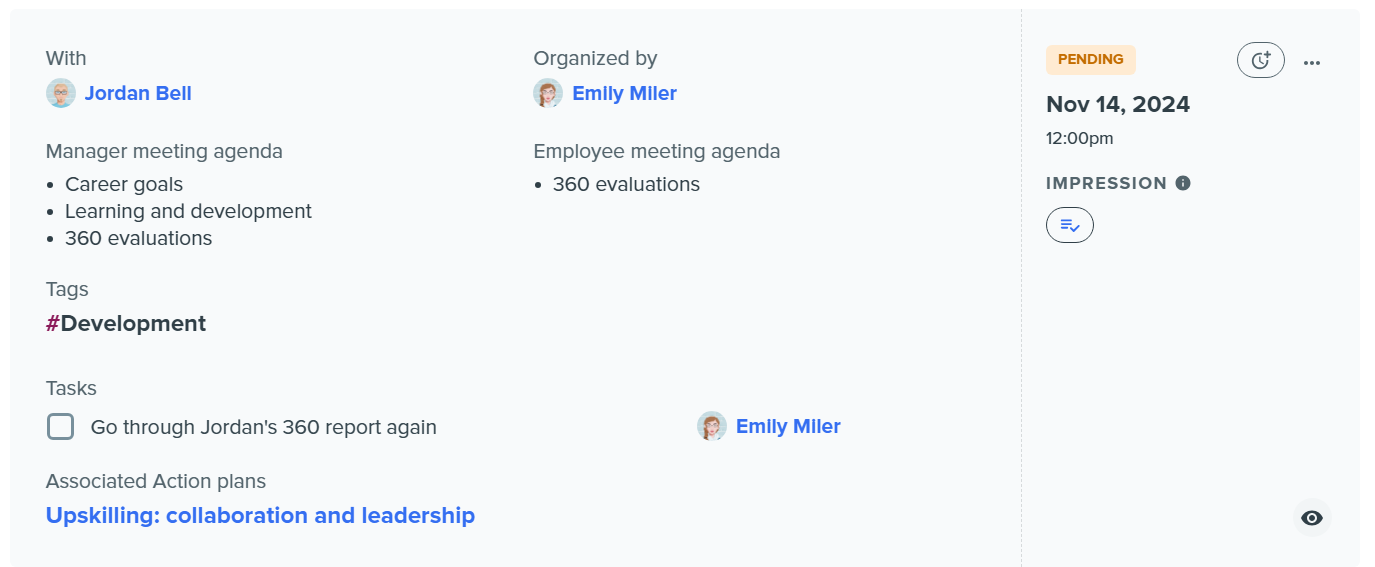
The main barrier to adopting a new one on one meeting software is not a lack of willingness, but rather a lack of time. If a platform requires extra setup or training, most managers stop using it after the first week. Employees feel the same way: when the interface looks complicated, they quickly revert to their own notes or spreadsheets.
Two elements make the difference:
- Calendar integration. Scheduling and reminders should run automatically in the background, so check-ins appear in the normal workflow without extra effort.
- Intuitive interface. Managers should be able to open the tool during a conversation without instructions, while employees know immediately where to find notes and goals.
💡 According to Gartner, the average HR information system achieves just a 32% adoption rate, with nearly half of HR leaders citing low user adoption as their top hurdle. This reinforces how critical simplicity and integration are.
Kadar integrates directly with calendars and offers a clean, distraction-free interface, so managers and employees can adopt it from day one without extra training.
2. Does it keep a centralized record of all one-on-one meetings?
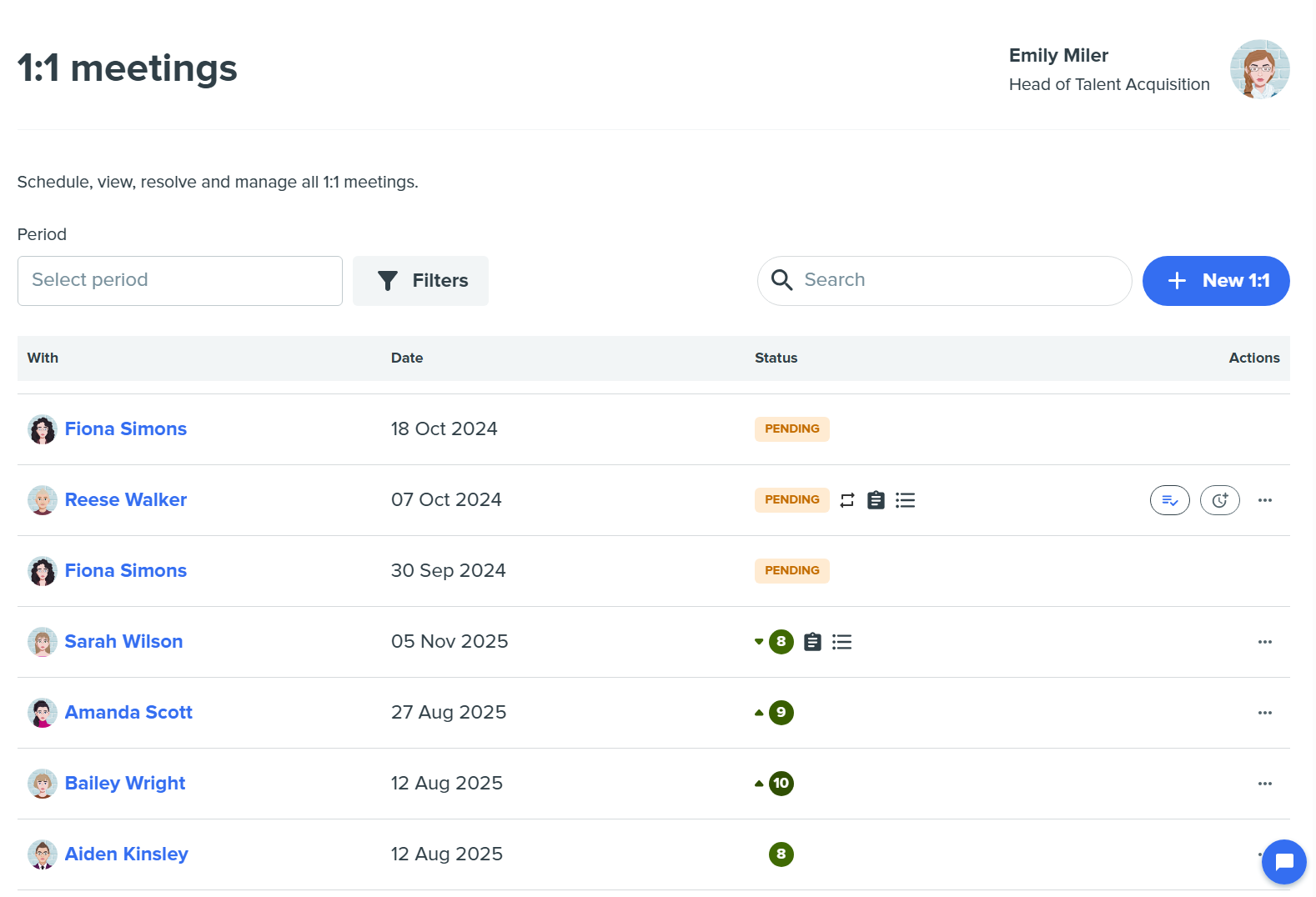
One-on-ones create value only when agreements and insights are captured in one place. When notes live across emails, Slack threads, and private documents, conversations become isolated check-ins that are easy to forget. Without a centralized system, even the best 1:1 meeting software can feel like just another note-taking app.
A strong system keeps every discussion in a single record. Shared notes provide both sides with the same view of what was agreed upon. A visible history shows how goals evolve, so each 1:1 meeting continues the last rather than restarting from zero. With continuity, accountability follows: commitments are written down, carried forward, and reviewed.
💡 Gallup research shows that employees who receive continuous feedback are 3.6x more engaged than those who don’t. Without a structured record, that loop breaks.
Kadar keeps every one-on-one in a shared timeline. Notes, history, and follow-ups remain connected, so both managers and employees see how discussions translate into long-term growth.
3. Can you create action items and follow up directly?
One of the most common frustrations employees share after one-on-one conversations is that nothing changes. Problems are discussed, but without a clear plan, they return in the next 1 on 1 meeting.
Activities after a 1:1 meeting are what drive change. Without concrete next steps, a 1:1 risks becoming just another complaint session.
A good platform should make it simple to turn discussions into concrete steps that move work forward.
Capturing the next steps in real time
The most effective conversations end with clear next steps. When a tool supports note-taking and task creation during the 1:1 meeting itself, commitments are visible immediately. Both sides leave with the same understanding of what happens next.
Assigning ownership
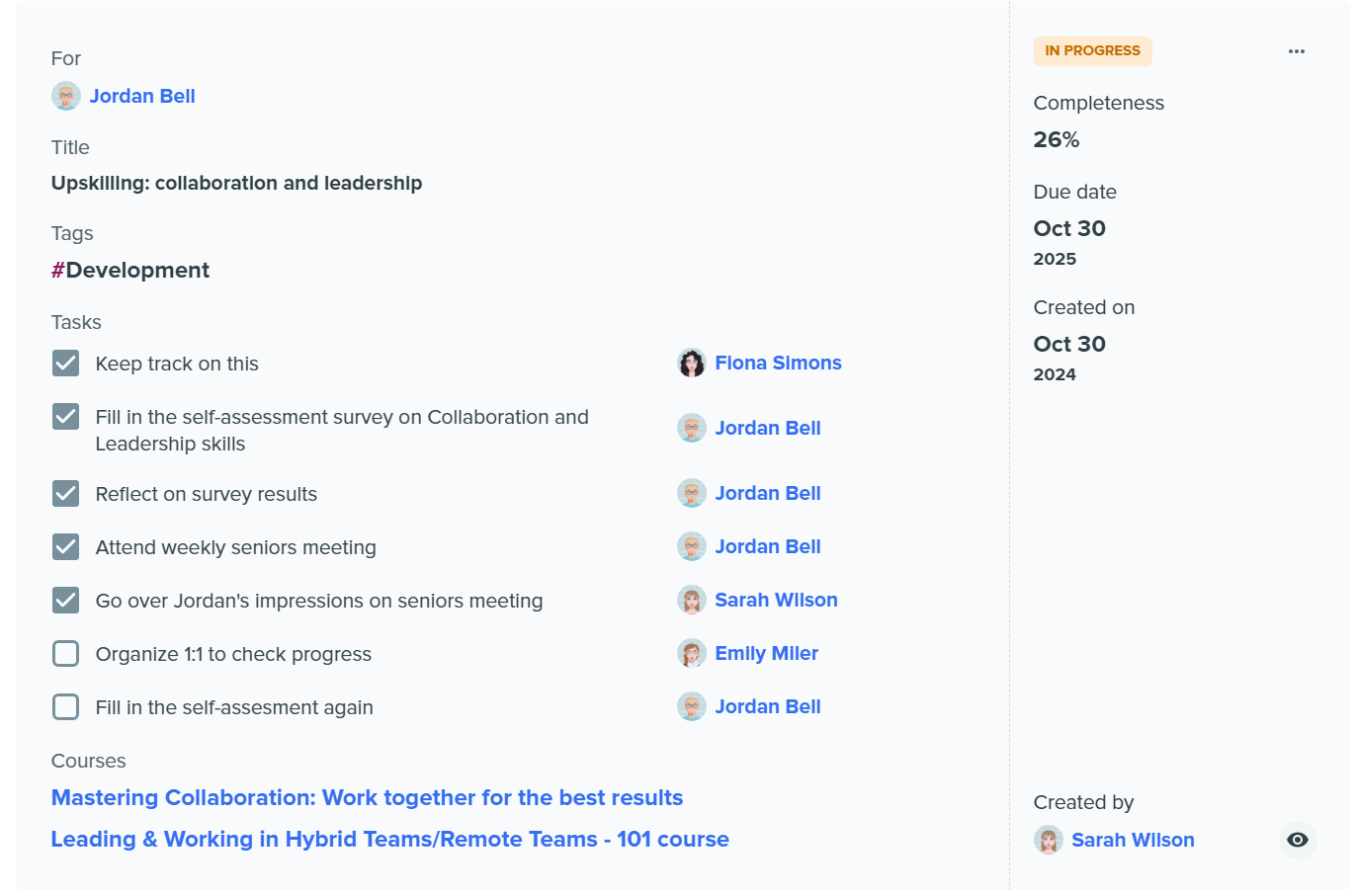
Tasks without ownership rarely move forward. A strong 1 on 1 meeting tool makes ownership visible: everyone knows who is responsible for the next step. The one on one meeting software should allow managers to assign action items to a specific person, set expectations, and revisit them later. This creates clarity for employees and a simple, non-bureaucratic way for managers to drive accountability.
Linking to development plans in Kadar
Short-term actions have a greater impact when connected to long-term goals. In Kadar, every action item can be linked to a career development path or growth framework, making progress measurable across time. Managers can highlight achievements in relation to larger objectives, while employees see how their everyday work contributes to their overall development.
Handled this way, one-on-ones stop being repetitive conversations and become a consistent driver of accountability and career growth.
4. Do HR and leadership get the visibility they need?
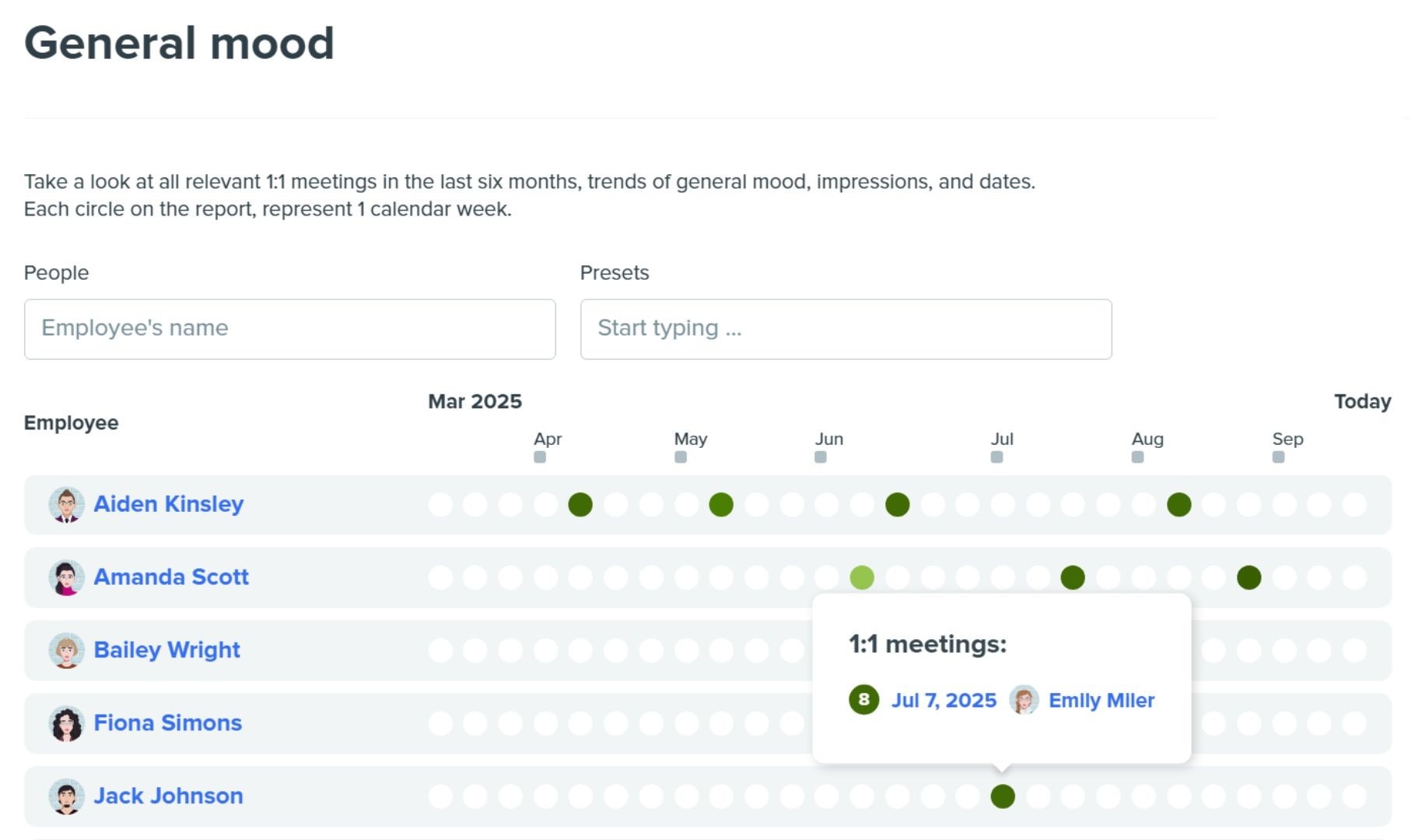
HR doesn’t run every conversation; HR coaches the process. To support managers and identify risks early, HR needs visibility into patterns and follow-through, not detailed transcripts from each 1 on 1 meeting.
Dashboards that show patterns
The right platform indicates whether check-ins are occurring, how often follow-ups are completed, and where managers may require support. With this view, HR can advise without micromanaging, and leadership can act on trends rather than isolated stories.
💡 Deloitte found that organizations with strong HR leadership alignment see up to 30–50% higher retention and engagement compared to peers without it. Visibility is essential, giving HR and leadership the leverage to influence long-term outcomes.
Kadar dashboards show HR and leadership where conversations are happening, how follow-ups progress, and which managers may need support.
Why implementation support matters just as much as features
Selecting 1:1 meeting software is only half the decision. The other half is how quickly it becomes part of work habits, how securely information is handled, and how well the vendor supports adoption over time.
- Fast rollout. The best tools make it easy to get started quickly, without weeks of setup or heavy training. Adoption improves when teams can experience value right away. With calendar sync and default templates, teams can start using Kadar in days, not weeks.
- Clear permissions. One-on-one conversations often include sensitive information, so a strong system must clearly separate private notes from shared ones and protect guest access. Kadar separates shared from private notes and manages guest access securely.
- Ongoing support. Choosing 1:1 meeting software is only the first step; teams need guidance to build lasting habits and adapt the tool to their context. Beyond software, Kadar provides hands-on customer support and expert advice to HR, helping managers build sustainable 1:1 meeting habits.
This matters because adoption is not a one-time event. Without guidance, even the best tool ends up unused. With continuous support, 1:1s become a repeatable process that delivers growth instead of disappearing after the first month.
Making the right choice of choosing one on one meeting software
Choosing one on one meeting software is not about the longest feature list. It’s about whether the tool improves meeting habits, including adoption among managers and employees, continuity from one conversation to the next, follow-through on action items, and visibility for HR and leadership.
Kadar was designed with these outcomes in mind. It helps teams capture meaningful discussions, turn them into actionable steps, and keep progress visible over time, while providing HR with the context to coach without micromanaging.
If your organization is evaluating tools, start with these four questions. They will help you see not just what a platform offers, but how it shapes behavior.