

Every leadership team eventually faces the same question: Is career development really worth the money? HR professionals talk about employee engagement and growth, but CFOs and CEOs want numbers. They want to know whether the programs they fund actually reduce costs, improve performance, or contribute to profit in any way.
Too often, employee development is viewed as a “nice-to-have”, an HR expense with benefits that are difficult to quantify. That’s why it gets cut first when budgets tighten. But research consistently shows the opposite: development is not a cost center, it’s an investment with a measurable return. From lower costs of employee turnover to higher productivity and stronger profit margins, the data is clear.
This article examines the evidence, highlights the actual cost of employee turnover, and demonstrates how organizations can measure whether their investment in employee development is yielding results or draining the budget.
Why leaders hesitate to invest in employee development
Even when leadership teams believe in the value of employee growth, development programs are often underfunded. The hesitation usually stems from three recurring barriers: a lack of clear ROI, a focus on short-term numbers, and fragmented processes that make it hard to measure impact.
Lack of measurable outcomes
Unlike sales or marketing, where results can be directly tied to business revenue, employee development is more challenging to quantify. Executives see training budgets and mentoring programs, but rarely see a dashboard that connects those investments to reduced employee turnover costs or increased profit. Without measurable outcomes, development can feel like a cost center rather than a value-creating investment.
Short-term vs. long-term focus
Quarterly reports drive decision-making in most organizations. Leadership seeks immediate efficiency gains, while the benefits of employee development (including better retention, a stronger culture, and higher productivity) unfold over time. That mismatch makes it easy to postpone or cut development initiatives, even though the long-term impact is substantial.
Fragmented processes that make ROI invisible
When training, mentoring, performance notes, and 360 feedback are stored across spreadsheets, slides, and private docs, it becomes impossible to connect investment to business outcomes that leadership actually wants: retention, productivity, and margins. Scattered evidence suggests that progress appears anecdotal rather than measurable. As a result, development is often viewed as an expense line, rather than a strategic lever.
Employee development vs. employee turnover
When leadership teams view development as a “nice-to-have,” it is often the first to be cut in budget reviews. But the data tells a different story: employee turnover is one of the most costly risks an organization can face, while structured employee development is one of the most reliable ways to reduce it.
The real question isn’t whether career development is worth the investment, but whether organizations can afford not to invest in it.
Performance and productivity through career development
Employee development directly impacts business performance, but neglecting it has visible costs.
When career growth slows down:
- Untrained teams take longer to adopt new tools and processes.
- Errors increase because knowledge is unevenly distributed.
- Managers spend more time on corrections than on innovation.
When talent development compounds:
- Teams projects move smoothly from idea to delivery.
- Skilled employees adapt faster and take on complex tasks with confidence.
- Managers can focus on higher-impact strategic decisions instead of rework.
💡 Research shows that structured training can increase productivity by 17% and boost engagement by 21%.
Retention and loyalty with talent development
Reducing the cost of employee turnover starts with building stability and trust. Employee development addresses the reasons people leave by showing them a clear path forward.
When organizations invest in growth, they gain:
- Higher retention → employees stay when they see opportunities to advance, not just tasks to complete.
- Stronger loyalty → structured career paths and mentorship create a sense of belonging and recognition.
- Cultural stability → development programs demonstrate long-term commitment, strengthening morale and trust across teams.
💡 According to LinkedIn’s Workplace Learning Report, 94% of employees say they would stay longer at a company that invests in their career development, if their company also invested in their career growth.
The financial burden of employee turnover

Even a single resignation creates visible and hidden costs that accumulate quickly. These costs, collectively known as the cost of employee turnover, include both direct and indirect expenses that affect productivity and profit.
- Recruitment and hiring → job ads, recruiter fees, and interview time all add up long before a new hire signs a contract.
- Onboarding time → it takes at least 3 months for new employees to reach full productivity, slowing projects and client delivery.
- Team slowdown → managers and teammates divert time to mentoring instead of growth initiatives.
💡 Gallup estimates that replacing leaders and managers costs around 200% of their salary, replacing technical professionals costs about 80%, and replacing frontline employees costs roughly 40%.
Employee development doesn’t just fill gaps, but amplifies existing talent, turning today’s performers into tomorrow’s leaders.
Building the business case
Even when leadership teams agree that employee development matters, career programs are often viewed as non-essential when budgets tighten. The problem isn’t a lack of belief in employee growth, but the absence of a clear, numbers-driven case. To win executive buy-in, the HR team needs to connect employee development directly to outcomes that leadership already tracks, such as retention, productivity, and cost savings.
The starting point is simple: show what it costs to lose people versus what it costs to grow them. When you calculate the cost of employee turnover, it becomes easier to demonstrate how investing in growth directly reduces financial risk.
Structured training or mentoring programs may appear expensive upfront. Still, the cost of employee turnover is significantly higher once recruitment fees, onboarding time, and lost productivity across teams are factored in.
To make the ROI visible to leadership, HR teams can:
- Link development to retention. Calculate the cost of replacing a single employee in a critical role and compare it to the cost of ongoing training and development.
- Track productivity impact. Measure changes in delivery speed, accuracy, or output within teams after structured development programs are introduced.
- Compare ROI against turnover cost. Place real, organization-specific numbers side by side to show executives where savings and risk reduction occur.
When development is framed in numbers leadership already understands, the conversation shifts from “Should we invest?” to “How much risk are we carrying by not doing it?”
If you want a practical starting point, this step-by-step guide to calculating the exact cost of employee turnover shows how to put real numbers behind that risk.
From numbers to practice: making ROI visible
Numbers alone rarely convince executives. Leaders don’t just want to hear that “development improves retention.” They want to see exactly how those improvements show up across their own teams, roles, and reporting cycles.
This is where many HR initiatives struggle. Even when the data is available, the connection between individual growth and business performance often remains unclear.
Imagine a CEO reviewing a quarterly report. Revenue is flat, turnover costs are rising, and productivity metrics are slipping. HR presents engagement survey results, but without a clear framework linking employee development to operational outcomes, the insights feel abstract and disconnected from business reality.
Tracking averages and patterns
Individual performance reviews are inherently subjective. What executives need instead are patterns and trends: how many employees consistently meet development goals, how retention shifts inside teams where managers run regular one-on-one meetings, and how employee engagement scores change after training programs are introduced.
By tracking averages over time, HR can demonstrate that employee development is not a feel-good initiative, but a repeatable system that influences measurable business outcomes.
Connecting data to outcomes
For the case to resonate with leadership, development data must be tied back to what executives care about most: growth, efficiency, and profit. When HR can show that higher retention reduces recruitment costs across the organization, or that productivity gains shorten delivery cycles within key teams, the narrative changes.
Employee development is no longer viewed as HR spend; it is recognized as a contributor to financial performance, with results that show up clearly in the organization’s results.
Making employee development visible to leadership with Kadar

For many HR teams, the real challenge isn’t a lack of data but the credibility of the data they present.
Leadership expects evidence that ties employee growth directly to business performance, and scattered spreadsheets or ad hoc manager notes rarely provide that confidence. What executives need is a system that ensures consistency, removes subjectivity, and makes the impact of development visible and trackable over time.
Kadar was designed around this principle.
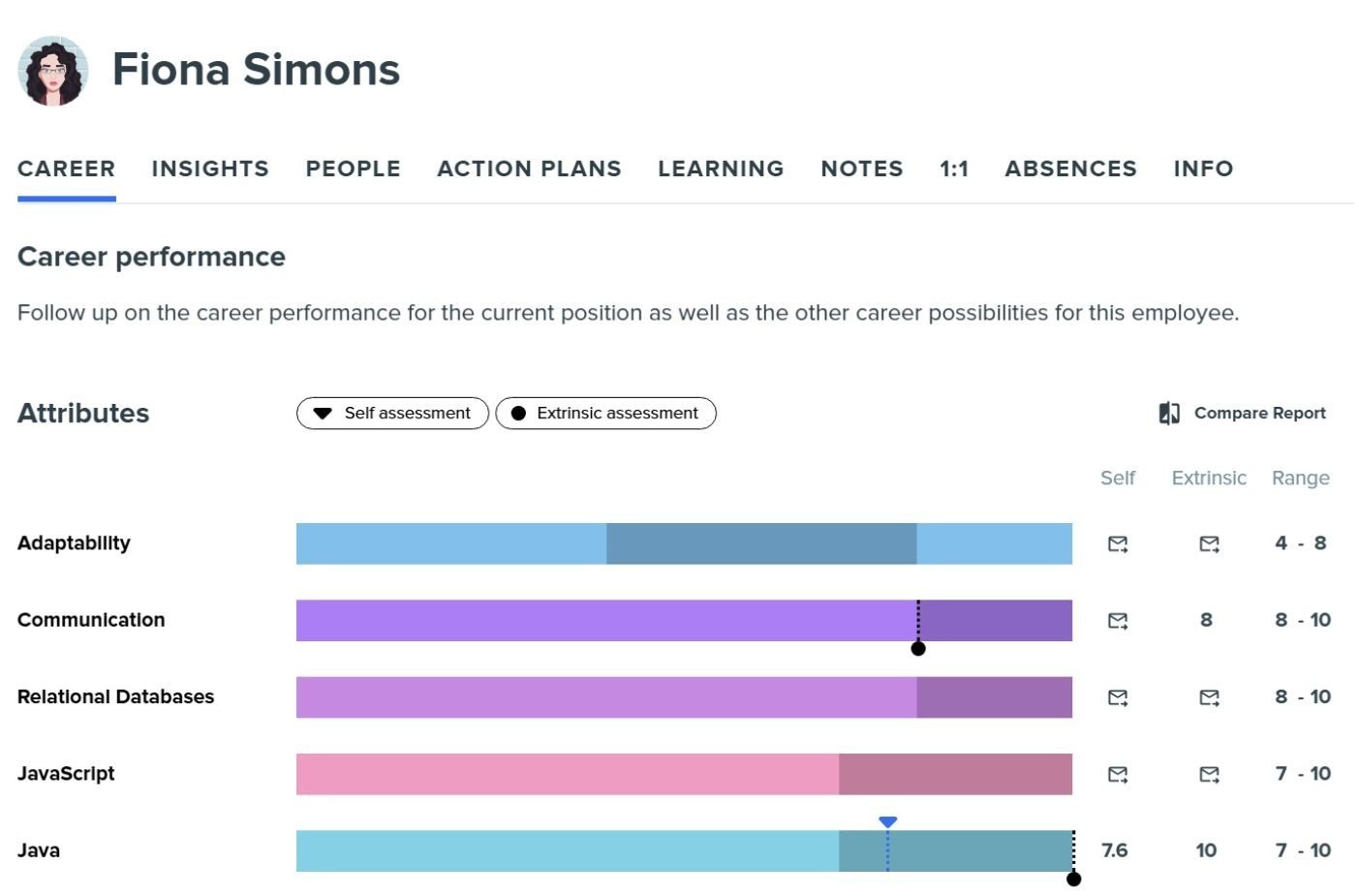
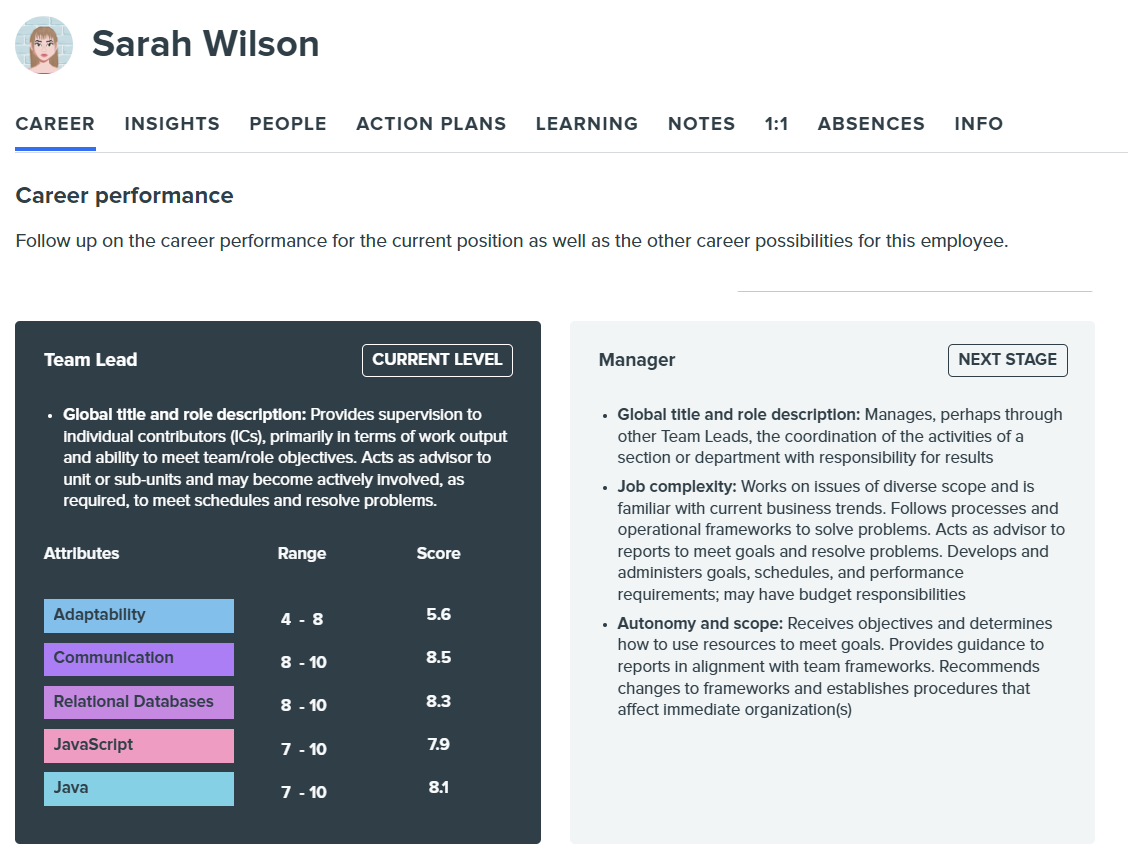
Instead of treating one-on-ones, feedback, goals, and leveling as separate initiatives, it connects them into a single workflow. Every action discussed in a meeting becomes part of a living plan with clear owners and deadlines. Progress is tracked across cycles and aggregated into patterns that leadership can immediately interpret, whether that’s recurring skill gaps or promotion readiness across the organization.
Take action: start with the basics that make employee development measurable. Try Kadar for free and see how structured one-on-ones, career goals, and 360 feedback help.
This level of structure changes the conversation with executives. Instead of asking them to trust HR intuition, Kadar helps HR present objective insights: how consistent development reduces the cost of employee turnover risk, how teams with active growth plans outperform others, and how employee engagement trends link to overall performance.
The tool is free for small organizations and scales with team growth, making it practical to adopt early without incurring heavy financial commitments. Most importantly, it provides the bridge between individual development and organizational outcomes, turning employee development from a perceived cost into a measurable investment.
Employee development is a measurable investment, not a cost
When budgets tighten, employee development programs are often the first to be cut. However, the evidence is clear: investing in employee development pays off in the most critical business metrics: retention, productivity, and profit.
Organizations that treat growth as a cost center face higher turnover, disengagement, and rising recruitment bills. Those who approach it as an investment build stronger margins, more resilient cultures, and employees who stay longer because they see a future for themselves within the organization.