

Spreadsheets and Notion are often the first choice for managing one-on-one meetings. They’re quick to set up, everyone has access, and in the early days, they feel flexible enough to keep basic notes.
However, once a team grows beyond 30 or 50 people, the system begins to break down. Many teams try to make effective one-on-one meetings work with spreadsheets and Notion, too, but these tools rarely scale beyond the basics. Managers conduct meetings in different ways, notes are scattered across documents, and follow-up tasks are lost.
For growing teams, the lack of appropriate performance management software isn’t just an efficiency problem but also a risk to retention and decision-making. Without structure, standardization, and visibility, it becomes almost impossible to plan employee development or connect individual goals with company priorities.
Why spreadsheets and Notion fail at effective one-on-one meetings
Tools like Notion and spreadsheets are fine for keeping notes, but they quickly fall apart when used to manage one-on-one meetings at scale. Instead of supporting growth, they introduce inconsistency, blind spots, and, ultimately, admin chaos. Here are the most common reasons why they fail:
No strategic people planning
Spreadsheets and Notion can capture meeting notes, but they can’t connect those conversations to a broader people strategy. There’s no way to link what was discussed in a 1:1 meeting to employee goals, leveling frameworks, 360 feedback, or performance review cycles.
Instead of turning conversations into actionable data, these tools freeze insights in static notes. Career development remains fragmented, and one-on-ones often become tactical check-ins rather than an integral part of a structured growth plan.
Without those connections, managers and HR miss the chance to align employee development with company priorities.
Manual work and security risks that don’t scale
What feels manageable with a handful of people quickly becomes unsustainable as the team grows. Instead of freeing up time, tools such as Notion and spreadsheets create a substantial administrative burden.
💡 A study of over 10,600 workers by Asana found that 58% of their days are lost to work coordination, not actual productive tasks. The same report found that workers waste six working weeks a year on duplicated admin work and meetings.
This situation not only wastes time but also erodes trust and fuels burnout, turning one-on-ones into another administrative burden instead of a source of genuine connection and team development.
In addition to the wasted time, there’s a real security risk: sensitive employee information often resides in shared links that can easily be leaked outside the organization. The larger the company gets, the more dangerous and inefficient this setup becomes.
No analytics or reports
One of the significant drawbacks of spreadsheets and Notion is the limited insight they provide. There’s no way to track patterns across meetings, measure action completion, or analyze sentiment over time.
HR and leadership can’t see whether one-on-ones are actually improving employee engagement or development. Without analytics or reports, decisions about promotions, team health, and team performance are based on scattered notes and subjective judgment rather than data.
What effective one-on-one meetings look like
Notion and spreadsheets can keep a record of conversations, but they don’t define what “good” looks like. Effective one-on-one meetings share a set of characteristics that make them consistent, actionable, and tied to employee growth.
Shared and balanced agendas
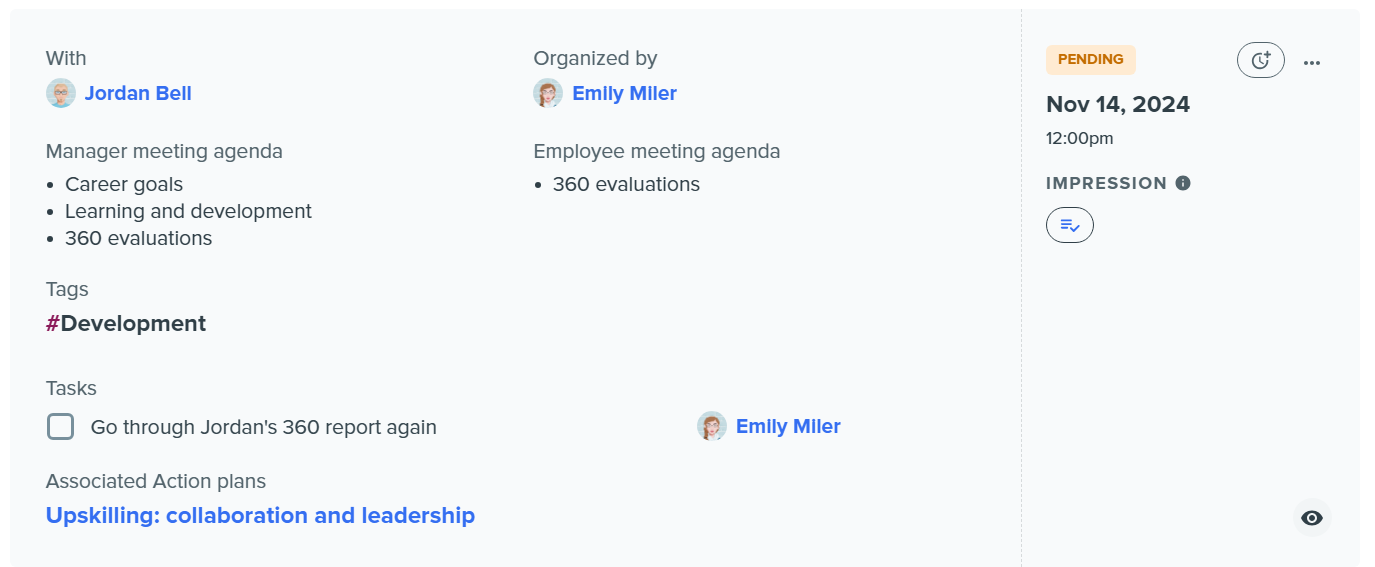
Some of our clients have completely flipped the ownership model: top performers, not managers, lead the agenda and take the notes. It sends a clear signal: one-on-ones are for their growth, not management’s checklist.
This approach increases meeting consistency and engagement, as employees come prepared with clear goals and follow-up points.
In Kadar, agendas aren’t buried in docs. Employees propose discussion points directly in the platform, and managers can add prompts linked to role expectations and goals. This ensures balance without adding prep overhead.
Action items with owners and deadlines
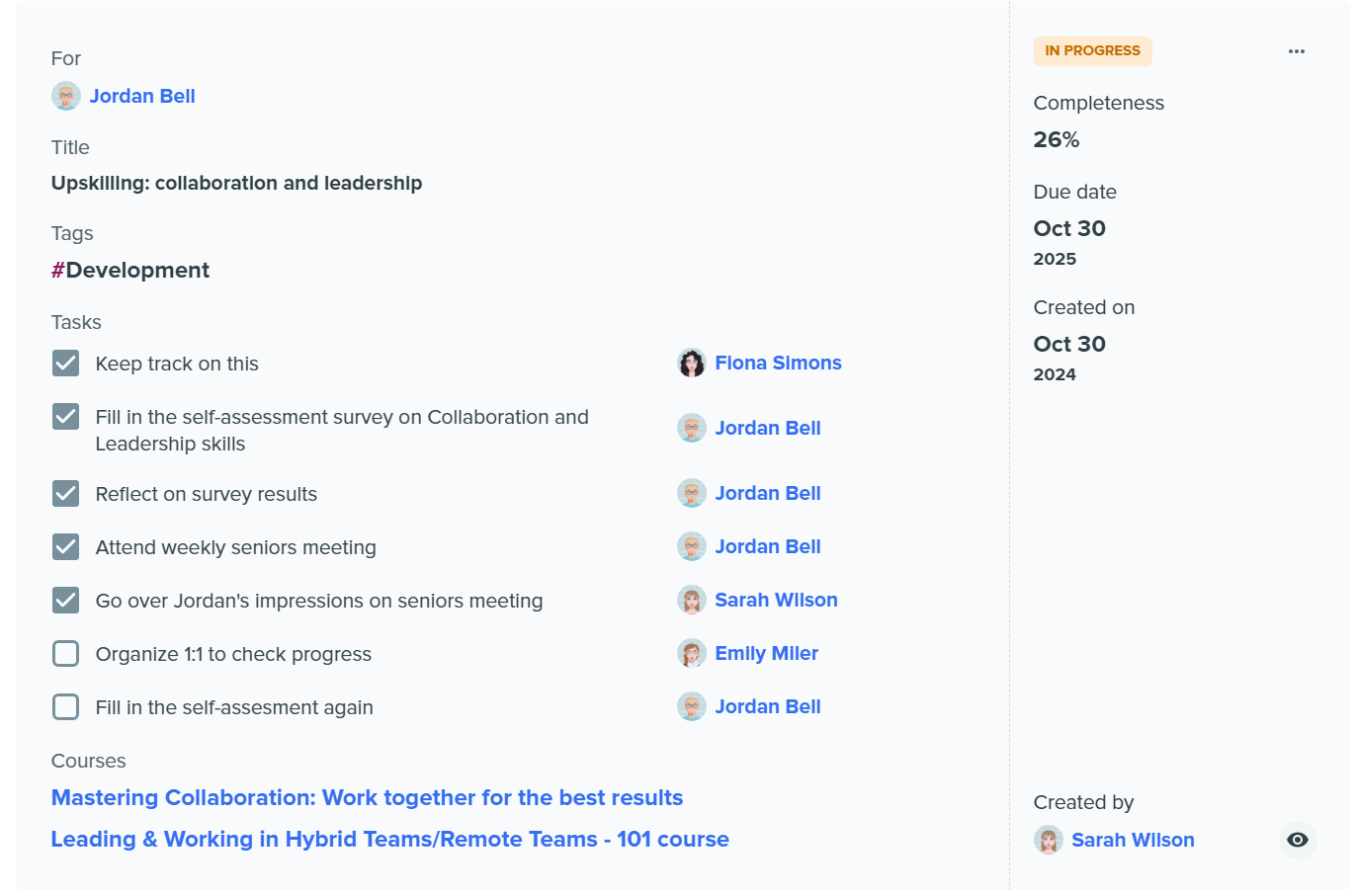
Action items create continuity and show employees that words lead to action. However, they also make development a shared responsibility, as HR, managers, and employees have visibility into the agreed-upon framework and who is responsible for what.
In Kadar, effective one-on-one meetings always end with specific action items, each with an owner and a deadline. These carry over into the next meeting, allowing progress to be reviewed instead of forgotten. That accountability loop is what turns one-on-ones into real change.
For example, if a developer commits to improving client communication, their manager can link that goal to a “Communication” skill in Kadar, while HR can monitor progress in future reviews. Everyone stays aligned, and growth doesn’t rely on memory or goodwill.
Data and analytics to track growth
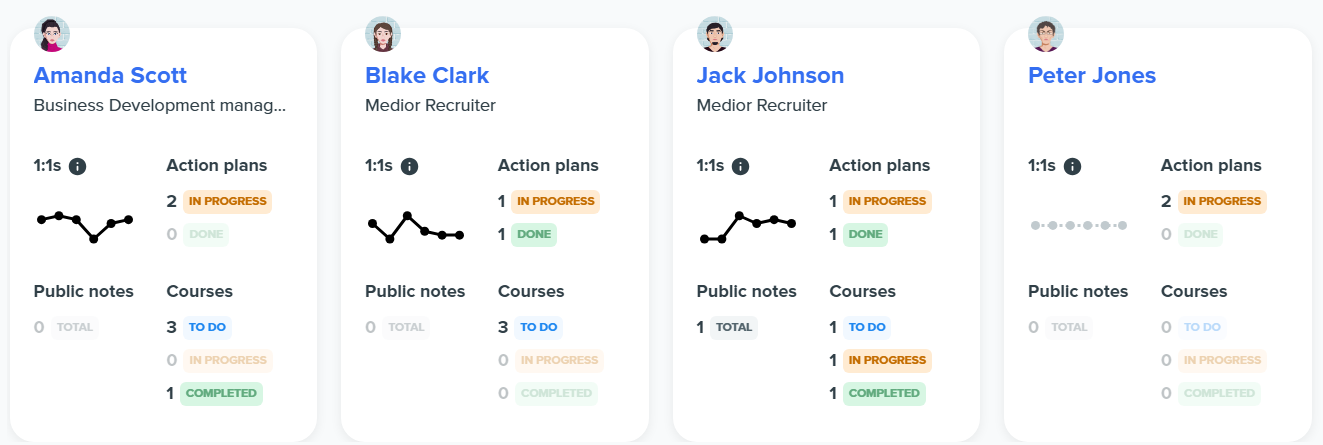
The value of one-on-ones with employees doesn’t end when the call is over. Tracking patterns across weeks, action completion rates, recurring topics, general mood, or engagement signals helps managers and HR see whether conversations are having an impact.
While effective one-on-one meetings generate this data automatically, Notion and spreadsheets can’t do this. They freeze insights in static notes.
With Kadar, you can turn one-on-ones into measurable data: managers see mood trends, HR identifies recurring blockers, and leadership receives evidence-based signals of promotion readiness.
Take action: move beyond notes and make one-on-one meetings measurable. Try Kadar for free and turn every 1:1 meeting into visible progress.
The cost of ineffective vs. the benefit of effective 1:1s
Ineffective one-on-ones don’t just waste time; they quietly create costs that compound as organizations grow. When conversations lack structure and follow-through, teams lose engagement, and leadership loses reliable input for decisions.
Effective one-on-one meetings, by contrast, do the opposite: they surface real issues early, build trust, and create a factual basis for growth and promotion decisions.
💡 A study of more than 1,000 employees by Spinach.ai found that workers were four times more likely to feel less motivated after a one-on-one than their managers expected. When meetings don’t lead to action, they actively undermine motivation instead of strengthening it.
Ineffective 1:1s drain engagement; effective ones create trust
When one-on-ones devolve into brief status updates or are inconsistent across managers, employees stop seeing them as a space for team growth. They show up, but they don’t bring real struggles or ideas because experience has taught them that nothing will change afterward.
Effective one-on-one meetings do the opposite. They create continuity, show follow-through, and signal that growth conversations matter. Employees come prepared because they trust that commitments will be revisited and acted on.
Ineffective one-on-ones waste time; effective ones support progress
When notes live in scattered documents, and follow-ups disappear, every one-on-one starts from scratch. Managers repeat the same conversations, decisions get revisited, and employees leave unsure what actually changed.
Effective one-on-one meetings create continuity. Action items are documented, owners are clear, and each meeting begins by reviewing what has moved forward since the last one.
Ineffective 1:1 meetings guess; effective ones decide
Without a reliable record of progress, managers and HR are forced to rely on memory and subjective impressions when making decisions about growth and promotions. High performers may be overlooked, while others advance without clear evidence.
Effective one-on-one meetings create a visible trail of development. Progress is documented, patterns are easy to spot, and promotion decisions are grounded in data rather than opinion.
💡 Gallup’s latest report shows that declining employee engagement costs the global economy $438 billion in 2024. Weak one-on-one practices contribute directly to that loss by disconnecting effort from recognition and progress.
Turning one-on-ones into people growth, not paperwork
When teams rely on spreadsheets or Notion, effective one-on-one meetings inevitably slip into scattered notes and inconsistent routines. What looks manageable at 10 people becomes unscalable at 50.
That’s where dedicated one-on-one meeting software makes the difference: it eliminates manual work and creates a structure in which every conversation builds upon the last.
If your one-on-one meeting management still lives in Notion or spreadsheets, that’s a clear sign you’ve outgrown them. It’s time to replace improvised processes with a framework that actually drives employee development.
See how Kadar’s 1:1 meetings software helps you run truly effective one-on-one meetings that scale with your team. Start for free and explore how it scales with your team.